Lesson Plan
TEACHING RESOURCES
First Steps
Guidelines to work with Indigenous Stories
Since Indigenous peoples and their way of life have been exoticized, marginalized, and colonized in the Western realm of knowledge systems, it is pertinent for teachers to understand how to work with Indigenous stories. Including Indigenous stories to teach a colonizer’s language in a responsible and respectful manner is challenging. Jo-ann Archibald’s (2008) book Indigenous Storywork and Parent and Kerr’s (2020) document “Indigenous Storywork Give Away for Educators” have been invaluable guides in my journey as a non-Indigenous, racialized educator in creating this curriculum. I draw on the teachings of ‘Storywork’ guided by respect, reverence, responsibility, reciprocity, holism, interrelatedness, and synergy (Archibald, 2008).
As teachers read the stories, they are encouraged to connect the narratives and cultural teachings to their roots in the land. Archibald (2008) emphasizes the importance of patience and trust to listen to stories. The act of listening to stories goes beyond merely hearing the words, the stories should be told in a way that listeners should be able to visualize the characters and the actions. As the Elders say, it is important to listen with “three ears: two on the sides of our head and the one that is in our heart ” (Archibald, 2008, p. 8). Essentially, we engage with Indigenous stories in a synergy - the teacher as the storyteller, the students as our active listener, and the story itself that offers important teachings.
In many Indigenous communities in Canada, the storytellers are trained from childhood, which can be daunting for educators who do not consider themselves skilled storytellers. A gifted storyteller has the ability to help their listeners visualize the story and its characters, making the narrator seem like part of the story. Lorna Mathias, a Nisga First Nations educator, observed during her graduate studies that her students noted several key traits of good storytellers: changes in intonation, expressive voice, physical actions, and most pertinently if the storyteller themselves display enthusiasm about the story ( Archibald, 2008, p. 132).
Ellen White, an elder and a gifted storyteller from the Stó꞉lō Nation of British Colombia recommends that teachers should first understand the story using visualization methods. For instance, drawing parts of story or storyboarding. She also recommends to read a page at a time, to read between the lines, recognize the levels of meanings embedded in the story, and immerse in the story to truly understand and value the story itself. This process would help in becoming a good storyteller (Archibald, 2008).
The act of telling or teaching through an Indigenous story requires a cultural framing and an understanding of the Indigenous community. Teachers are encouraged to research the communities mentioned in the units and prioritize reading texts written by the community itself rather than by outsiders. Archibald(2019) recommends that teachers use storybooks written by Indigenous people and learn to read and tell the stories that way. Once familiar with the stories, teachers can move to telling them without the book, but it is crucial to share the context and acknowledge the source of the story. There are cultural protocols or guidelines for working with Indigenous stories. As Archibald (2019) explains, there is a difference between traditional cultural stories and personal lived experience stories, with the latter being outside the purview of using them as teaching stories in a public forum.
For non-Indigenous teachers like us, it is crucial to culturally sensitize ourselves to the process of incorporating Indigenous stories in our curriculum. Providing context by showing pictures of the authors/storytellers, and the nations they come from will help learners connect with the people and places from where the stories originated. It is also important to remind students that many versions of oral narratives coexist, each told differently by various storytellers for diverse audiences. Unlike Euro-Western stories which are often written for children, Indigenous stories contain important teachings embedded within them, meant not just for children but also adults. Indigenous stories also do not follow the typical Euro-Western structure of having a tidy beginning, middle, and end. Instead, they often end in a moment of reflection, encouraging listeners to engage personally with the story and ponder on how the story might have ended. The meanings are often open-ended. The stories chosen for this curriculum unit reflect values for living in harmony with the territory and the land.
References:
-
Archibald, J. (2008). Indigenous storywork : educating the heart, mind, body, and spirit. UBC Press.
Archibald, J. (2019, August, 14). For educators. Indigenous Storywork. https://indigenousstorywork.com/1-for-educators/
Parent, A. & Kerr, J.(2020) Indigenous Storywork Give Away for Educators. Indigenous Storywork.com. https://indigenousstorywork.com/resources/
Archibald, J. (2008). Indigenous storywork : educating the heart, mind, body, and spirit. UBC Press.
Archibald, J. (2019, August, 14). For educators. Indigenous Storywork. https://indigenousstorywork.com/1-for-educators/
Parent, A. & Kerr, J.(2020) Indigenous Storywork Give Away for Educators. Indigenous Storywork.com. https://indigenousstorywork.com/resources/
Pedagogical Rationale
Stories are common to every culture, however they hold different meanings in different cultural contexts. As adults we tend to forget the stories that we heard as children from our grandparents or parents. Gray (2012) addresses the issue of how cultural materials are now used as forms of mass entertainment through the rise of cinema and television. Consequently, it has become more common for us to watch movies and listen to podcasts in our fast-paced technological world. Through the oral narratives, it is my attempt to reacquaint learners with the oral tradition of storytelling.
The lessons are designed on the principle of holism, representing the interconnectedness
between the spiritual, intellectual, emotional, and the physical world that forms a whole person (Archibald, 2008). The image of a circle, used by many First Nations communities in different ways symbolizes “wholeness, completeness, and ultimately wellness,” (p.11) involving the individual with the family, the community and the nation. This is framed in the understanding that we are responsible for our future generations and our ancestors, extending beyond human relations to include more-than-human beings — animals, birds, flowers, trees, rocks, land and other beings. The goal of these lessons is to raise the ecological consciousness by using language that is more nature-centric and critically examining the anthropocentric ways of viewing nature.
The lessons are designed organically, so grammar does not dictate their structure. Students are encouraged to engage in dialogue and reflective thinking that generates language. Teachers can choose to explain a grammatical structure at the end of the lesson based on the language generated by the students, teaching grammar organically. Alternatively, the teacher can explain the grammatical structure the next day, allowing time to prepare and recap the previous day’s learning. This approach provides an alternative to the structuralist and competency-based framework of teaching a language (Canagarajah, 2020).
The units are organized to present alternative ways of viewing the natural world, challenging the current utilitarian perspective that sees nature as a resource. Although the focus of the lessons is on skills development, especially listening, reading and speaking, the purpose of these lessons goes beyond skills development to address the spiritual and emotional dimensions of learning from the land. Many of the activities are inspired by the concept of visual metaphors, encouraging learners to engage with the content spiritually and emotionally (St. Clair, 2000).
The lessons also do not suggest time-bound activities. Unlike Western understandings of time, in the Indigenous worldview,
“things happen when they are ready to happen"...time is not “structured into compartments.…" The solution is to allow for flexibility and openness in terms of time within practical limits” (Dr. Gregory Cajete,1986).
References
- Archibald, J. (2019, August, 14). For educators. Indigenous Storywork. https://indigenousstorywork.com/1-for-educators/
- Cajete, G.A. (1986). Science: a Native American perspective: A culturally based science
education curriculum. Unpublished doctoral dissertation, International College, Los Angeles.
- Gray, J. (2012). Neoliberalism, celebrity and ‘aspirational content’ in English language teaching textbooks for the global market. In D. Block., J. Gray., & M. Holborow. Neoliberalism and Applied Linguistics. Taylor & Francis Group.
- St. Clair, R. N. (2000). Visual Metaphor, Cultural Knowledge, and the New Rhetoric. ERIC.
education curriculum. Unpublished doctoral dissertation, International College, Los Angeles.
Lesson Plans
UNIT 1 - Creation Stories
Rationale
In ELT, metaphors are often understood as a literary device that enhances the quality of one’s writing. However, metaphors are ways in which we understand life. It is hidden in the words we use. Lakoff & Johnson (2003) tell us that “metaphor is pervasive in everyday life, not just in language but in thought and action (p.3). The authors state a simple example showing how certain concepts govern how we view the world and relate to people. The cultural values of consumerism for example come from expressions like “more is better,” “bigger is better” (p.22). Hence, the accumulation of wealth and goods becomes embedded in cultures driven by the English language.
The creation stories in this unit chosen from the Indigenous nations of Canada will introduce students to the language of ecology. The lessons also act as a way of introducing the metaphorical nature of Indigenous stories that are grounded in specific cultural values. The sources of Indigenous knowledge are the land, the spiritual beliefs and ceremonies, the traditional teachings often embedded in the stories (Archibald, 2008). In this lesson, Ss will be introduced to the phrase “All my Relations.”
Thomas King, Cherokee storyteller explains,
All my relations is a first a reminder of who we are and of our relationship with both our family and our relatives. It also reminds us of the extended relationship we share with all human beings. But the relationships that Native people see go further, the web of kinship extending to the animals, to the birds, to the fish, to the plants, to all the animate and inanimate forms that can be seen or imagined. More than that, “all my relations” is an encouragement for us to accept the responsibilities we have within this universal family by living our lives in a harmonious and moral manner ( as quoted in Archibald, 2008, p. 42).
Level: Upper intermediate
Number of students: 15
Total duration: 90 mins + 90 mins
#1 “Skywoman Falling” - A creation story adapted from the oral tradition, and Shenandoah and George,1988 published in the book Braiding Sweetgrass by Dr Robin Wall Kimmerer.
# 2“Creation Story” - Told by Grand Chief William Charlie from the Sts’ailes Nation, British Colombia, Canada.
Objectives:
-
By the end of the lesson, Ss understand the values of community, relationality, generosity and sacrifice.
-
Be able to reflect on the nature of reciprocity and responsibility between humans and the Earth.
-
Be able to identify ecological metaphors.
-
Be able to narrate a story in their own words.
Before beginning the Teacher (T) should sensitize Ss about Indigenous communities.
T could start the discussion by eliciting if they know the word “Indigenous”. What do they understand by it. Do they know of any Indigenous communities from their country?
Lesson 1 - Skywoman Falling
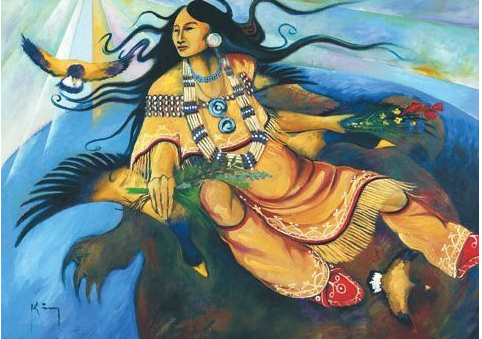
| Lesson Stages | Objective | Activity |
|---|---|---|
| Lead in | To understand the meaning of creation stories and remember creation stories from the students own culture. | T to Ss -
|
| Listening | To activate memory and listening skills. | Classroom seating - Circles - This is adopted from the First Nations Pedagogy(2009) of the Talking Circle. [firstnationspedagogy.ca/circletalks.html](http://firstnationspedagogy.ca/circletalks .html) Ts are encouraged to read the website. The idea is to encourage Ss to be engaged with their hearts and minds as they listen to the story. T tells the story of the “Skywoman Falling” to the students. The teacher is encouraged to tell the story instead of reading, encouraging students to pay attention to the intonation. T to refer to the Teacher’s Guide at the beginning for storytelling. |
| After listening | To show understanding |
|
| Reading | To comprehend the story and learn new vocabulary. |
|
| Speaking | Discussion questions |
Ss to discuss the questions in pairs, followed by WCFB. |
| Freer Task - Speaking | Telling a creation story | Referring to the story map Ss had created earlier, T asks the Ss to create a story map of the creation story from their own culture. Give Ss time to prepare. Ss in pairs now tell the story to each other. Encourage students to use the vocabulary they learnt from the story “Skywoman.” The activity could be done in groups of 3-4 as well, depending upon time. |
| Feedback | Reflection |
T to elicit the values Ss learnt from the story.
T to elicit new vocabulary the Ss learnt. What did the Ss learn about storytelling? How did they feel after sharing stories from their own culture? |
Lesson 2 - Creation Story from the Sts’ailes Nation
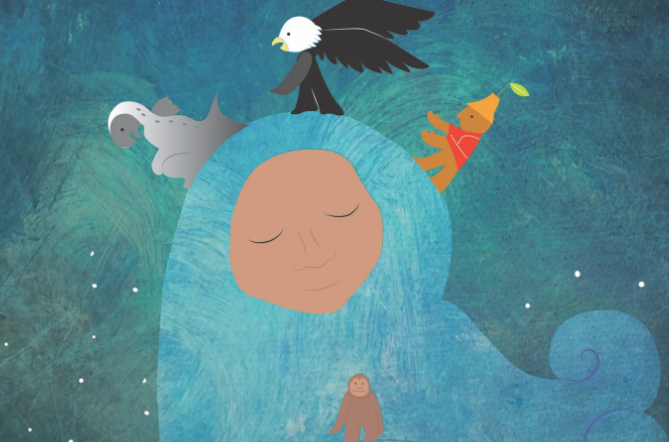
| Lesson Stages | Objective | Activity |
|---|---|---|
| Lead in | To reflect on the nature of relationship humans share with the natural world. |
Ss are seated in the Talking circle again. Ask students to share their understanding of the interactions between humans and more-than human beings. They can think of both positive and negative interactions based on their cultural understanding and experiences. Encourage them to think on their personal experiences.
Note: T might across complex areas like pet animals, domesticated animals and animals in zoos. All these forms do reflect on the nature of humans keeping animals captive either for entertainment, emotional support, food etc. |
| Reading | To understand the story. To practice reading and pronunciation skills. |
T to handout copies of the story.
Read the text aloud with Ss taking turns. Discuss the central themes of the story - the origin of the world, the evolution of life, the interdependence of all living things, and the responsibilities humans have towards nature. |
| After reading task | To show understanding through art. |
|
| Speaking | To explain the art to the class. | Ss in groups explain their visual representation of the story. |
| Feedback | Reflection | Encourage ss to think and share on how the teachings in the text can be applied in modern life. T to help with language where necessary. |
UNIT 2 - Where does our food come from?
Rationale
Globalization has led to the easy movement of commodities across the world. Human beings as consumers find things from remote corners of the world in supermarkets with relative ease. This unit allows the Ss to reflect on where and how the food they eat come to them. As Harrod (2000) says, “in urban centers, many generations of children have matured into adulthood without any primary experience of domestic animals and no practical knowledge of where food products such as milk or eggs originate” (p.xxiv). This unit also challenges Western cultural assumptions of animals as resources. The Indigenous oral traditions “are rich with examples of how animals gave their bodies to the people, often agreeing to become food because they have established kinship relations with humans” (Harrod, 2000, p. xii). These stories often show that animals are beings with agency and not passive receivers of human’s action
Level: Upper intermediate
Number of students: 15
Total duration: 90 mins + 90 mins
#1 The Bitter Reality of the Bitter Brew
#2 “How food was given captikʷɬ” - The Four Food Chiefs - This oral history is borrowed from Syilx Okanagan People residing in the Southern Interior of British Columbia. It tells the story of how food was given to the Okanagan nation.
Objectives:
-
By the end of the lesson, students reflect on the food culture that is influenced by the modern world and its contribution to environmental damage.
-
Understand the values of sacrifice, generosity, responsibility and community.
-
Be able to reflect on the relationship between humans and more-than-human beings.
-
Be able to critically analyse the root metaphors of nature-centred cultures and industrial cultures.
Lesson 1 - The Bitter reality of the bitter brew

| Lesson Stage | Objective | Activity |
|---|---|---|
| Lead in | To activate schemata |
Whole class discussion
|
| Reading | To enhance reading and comprehension skills. |
Jigsaw reading activity (4 paragraphs)
T to monitor the discussions and assist students as needed. How to conduct the activity
|
```
| Language focus | To pay attention to linking words and phrases. | T to elicit from Ss, what did they learn about coffee farming. This is to be followed by feedback on the correct sequence of the text. Elicit from Ss what helped them to identify the sequence. Highlight the linking words/phrases. Elicit a few more options. |
| Final Task - Speaking | To research and present on the source of food items Ss consume. |
|
| Feedback | Reflection |
T elicits from Ss what did they learn from this activity. Is it important to think about where does our food come from?
T could also give language feedback in the form of error correction. |
Lesson 2 - "How food was given captikʷɬ” - The Four Food Chiefs
This story is borrowed from the Syilx Okanagan People who reside in both Canada and the United States.
| Lesson Stage | Objective | Activity |
|---|---|---|
| Lead In | To think about the key themes of the story. |
Ss sit in the talking circle. Introduce the concept of a "talking
piece" which will be passed around to ensure everyone has a chance to
speak and be heard. A small token (like a feather, stone, or leaf) to
represent the talking piece.
T to start the sharing circle by holding the talking piece and sharing something they are grateful for in their life. E.g. "I am grateful for the trees that give us air to breathe." Pass the talking piece around the circle, allowing each student to share something they are grateful for. Encourage them to think about things that come from nature (animals, plants, water, etc.). |
| Listening | To activate listening skills. | Ss continue to sit in the circle. T tells the story of the “Four Food Chiefs” to the students. It is important to share where the story comes from. T to use the right intonation, and stress to model a good example of storytelling and to engage the students. |
| After Listening | To check comprehension |
T asks simple comprehension questions to check students understanding
of the story.
E.g. Why do more-than-human beings come together? Who are the four food chiefs? |
| Speaking | To extend Ss understanding of the key values in the story. |
In pairs/group
|
| Reading | To gain a deeper understanding of how the story is connected to the Syilx Okanagan People. |
T to provide handout of the story. Ss read the story silently and
complete the table in pairs. An example has been given.
Instruction for T - The students at this stage, might not comprehend the values as they come from Okanagan Nation. Ss at this stage could offer their understanding. Encourage them to share their cultural connection/meanings with these plants and animals, if any. T to provide details during the feedback stage. |
| Speaking | To engage students in a discussion that deepens their understanding of the themes in the story and enhances their speaking skills. |
Index cards with the questions written on them. Divide the students
into pairs.
Give each pair an index card with one of the three questions:
Facilitate a class discussion based on the pairs' presentation of ideas. Use follow-up questions to deepen the discussion:
|
| Feedback | Reflection | Elicit from Ss the importance of collaboration, respect for nature, and the wisdom we can gain from traditional stories. Encourage students to consider how they can apply the lessons from the story in their own lives and communities. Encourage students to think about how they can incorporate gratitude and respect into their daily lives, not just for people, but for nature and all the gifts it provides. |